My friend Stephanie arrived in NOLA a couple of weeks ago, and began looking for an apartment. Of course I offered to drive her through what I consider the "good" neighborhoods to look for rentals.
As we drove through the Black Pearl, one of the nicest Uptown neighborhoods, Stephanie suddenly asked me "are you sure this is a good area?"
"Positive," I said. "It's beautiful here."
"But what about the graffiti?" Stephanie asked me.
I looked in the direction she seemed to be looking. "Graffiti?" I asked, not able to figure out what she was talking about.
"Right there, the X on those buildings!"
"Oh!" I said. "THAT graffiti."
We here in NOLA live with so much Katrina lore around us that we hardly notice it anymore. That conversation set me thinking: just how much Katrina destruction is still evident in the city? This is something people ask me about all the time when I travel. So I set out with my camera to see just how much Katrina damage still exists today, February 2012, six (nearly seven) years later. (By the way, we'll get to those X graffiti marks in just a minute).
I started out in my own neighborhood, Carrollton/Riverbend. There was very little damage here on August 29, 2005. Most of the serious flooding was downtown. But I found one legacy of Katrina just a block from my house: a looming vacant building where a public school should be.
Since Katrina no public schools have been functioning in New Orleans. None. All education is done by charter schools and private schools, and students who would otherwise attend public schools are given credits to go to these schools. The good news is, public school students are getting a private school education. Of course, not all students take advantage of this. Vacant school buildings loom all around the city. A few are just now being rebuilt.
Next I went to the Upper Ninth Ward, also called the Saint Claude area. There's a block I pass on my way to the French Quarter every day on which almost all of the houses are abandoned and damaged (the block of Claiborne between Saint Bernard and Touro). On the day I visited, one house was being rebuilt. Most are still damaged:
Here a home on the same block is marked as condemned, and the property is apparently for sale. Notice the vines growing on the upper floor.
From there, I went into the Lower Ninth Ward. This is the part of New Orleans hit hardest by Katrina. Because the levee is fairly nonexistent here, the canal flooded this area with over fifteen feet of water. Here's a picture taken a few days after August 29, courtesy of
katrinadestruction.com:
The flood water is receded now, but most of the buildings there still show signs of the storm, from boarded up windows to complete destruction. I have to say I had no trouble finding damaged and wrecked houses pretty much everywhere in the Lower Ninth:
The good news is I also saw a lot of building going on. Most blocks showed some sign of reconstruction. In the photo below, a house has been cleared away, leaving only a few foundation stones, and the property is being sold by the owner.
In the wake of destruction, a lot of wildlife seems to have found new homes. I saw this handsome guy eating frogs from a large puddle behind a wrecked home:
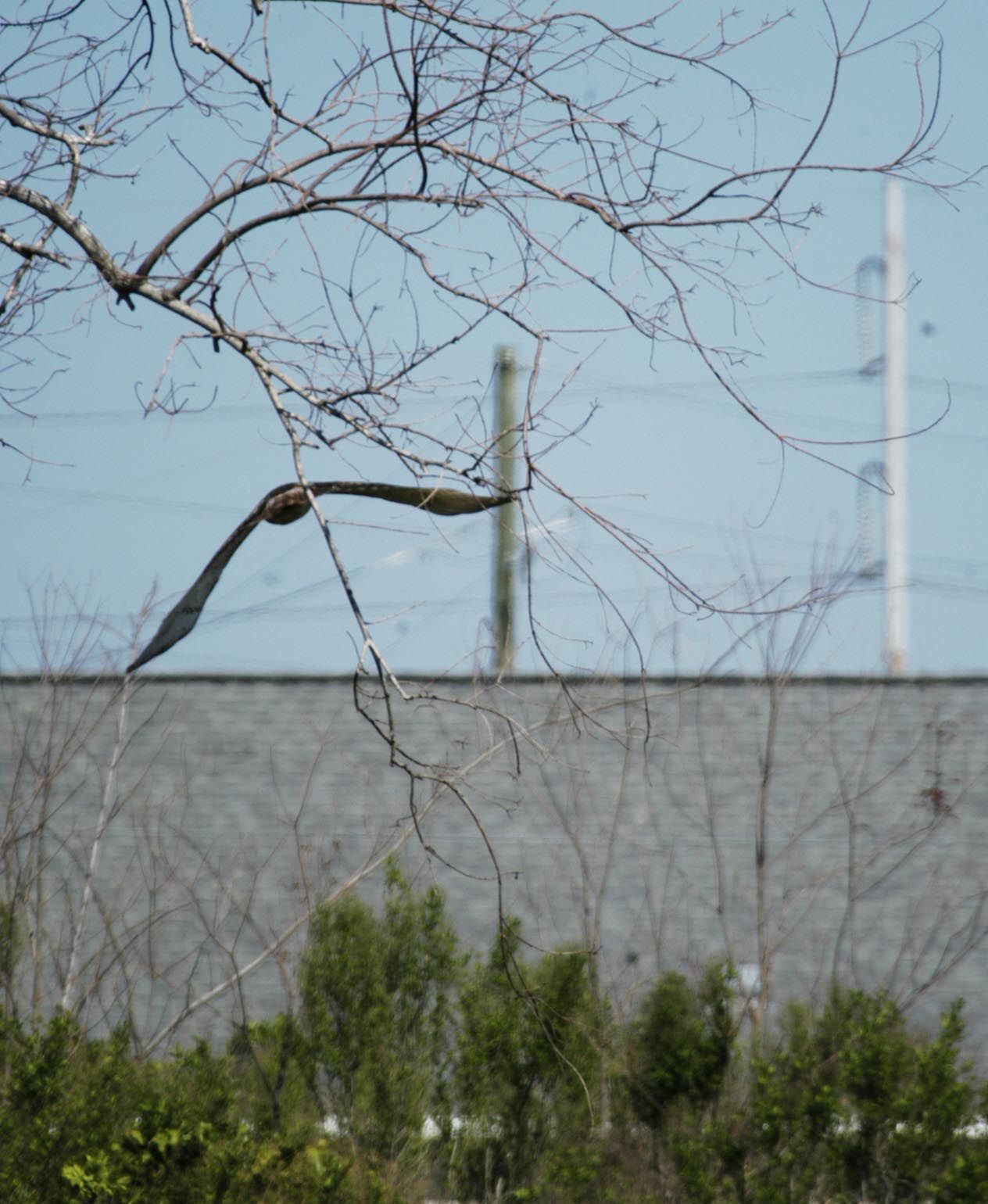
And this guy lives by the levee (he may be hard to see in these photos; he's a very large hawk):
Still, my two days of visits to the Lower Ninth to take these photos was overall pretty depressing. I'd say there's two detroyed homes for every one that's lived in or rebuilt. I saw workmen at maybe five or six sites, so there is hope.
At the beginning of this Blog I mentioned my conversation with Stephanie, and the graffiti she noticed on houses in one of the finest of neighborhoods, The Black Pearl. I also mentioned that we here in New Orleans have lived with that particular graffiti for so long, we hardly even notice it anymore.
I know you're asking, what are you talking about Kenny? OK, I'll tell you.
In the weeks following Katrina, National Guard units from several states, private volunteers and several federal agencies began searching every house and structure in flooded areas. Bodies were found, survivors were rescued, and hazards such as gas leaks were noted. Written records and electronic notations were useless in the wake of this kind of destruction. So workers left a record of their visit in spray paint on each home in the city.
This record usually took the form of an X, the FEMA standard (down here we call FEMA the Federal Emergency Mismanagement Agency). Here is the official chart explaining the markings in the X:
This was not an easy task. Many houses could not be entered, because the flood water reached above the doors and windows. Rescuers often simply looked inside through windows or holes, guessing whether anyone was alive or dead inside. Courtesy of
Katrinadestruction.com, here is a photo of a volunteer worker marking a house during inspection.
You can see what rescuers faced. There's really no way to get inside this home without swimming. These heroes, and they are true heroes, did the best they could in those few weeks after the storm.
Here are some markings on houses in the Upper and Lower Ninth Wards:
Upper Ninth: On September 16 (18 days after Katrina hit) the Oregon National Guard could not enter the home (NE). The following day the California National Guard entered the building and found no bodies, living or dead.
Lower Ninth: On September 12 the home was visited but no note was made (probably because volunteers could neither get inside nor see in). On September 16 the California National Guard could still not get inside (NE).
Lower Ninth: Here in faded green, on September 12 the Texas National Guard could not enter the building; in bolder paint, the California National Guard arrived on September 17, and found no bodies.
Animals were also rescued during the volunteer attempts. When they could not be removed, food and water was left for them. After the Texas National Guard found no bodies here, an agency left pet water with a slight sense of humor.
One of the strangest marks on homes in the Upper and Lower Ninth Wards is the acrynom TFW. In the years following the storm there were many ideas about about what these letters stood for. One suggestion was Toxic Flood Water. The trouble with that suggestion was that all of Downtown was covered in toxic flood water. Another was Totally F----ed Way-up.
It turns out the letters stand for Task Force Wildcat, a rescue unit made up of National Guards from several states, and under the command of the West Virginia National Guard.
TFW had their own ways of marking buildings. They never used FEMA's X marking, and in most cases each building they marked has a different pattern. They also seemed to maintain a dark humor in the wake of the horror and disaster they saw. In a word, these guys are awesome. Here are some TFW markings from the Upper and Lower Ninth:
In these two cases TFW found no bodies on September 12. In the lower photo they could not enter the house. Their zeros are very badly formed (above) and were apparently the cause of much confusion.
Here the Oregon National Guard and TFW seem to have visited a house together. Notice TFW circled their call letters... no bodies were found but the home could not be entered.
TFW were just as concerned with rescuing animals as they were people. This house bears a discussion between TFW and city workers: on September 12, TFW inspected the home. They could not enter, and found no bodies. On September 27, city workers coming to make sure the gas was shut off saw a small dog. On October 18, TFW returned, saw no dog, but left food and water (F/W) in case the dog returned.
I'm not sure if I can tell you why, but when I see the TFW code now, I feel very connected to these rescuers.
This all seems like ancient history now, 2005, nearly seven years ago, but remember that I took all of these photos in the first two weeks of February 2012. These scars on the city are very present. As my awesome girlfriend Lauren said to me just the other day, New Orleans is a city where great beauty and creativity lives side by side with great ugliness and squalor. Maybe that's what we love about living here.
From New Orleans, this is Kenny Klein explaining it all.